1997–98 FIS Ski Jumping World Cup – Zakopane
The 1998 Zakopane Ski Jumping World Cup was a series of ski jumping competitions held as part of the 1997–98 FIS Ski Jumping World Cup from 16 to 18 January 1998 at Wielka Krokiew in Zakopane, Poland.
Two individual competitions were contested on the large hill. This marked the fourth time that ski jumpers competed in Zakopane for World Cup points. These were the 13th and 14th competitions of the 1997/1998 World Cup season.
In the first competition at Wielka Krokiew, Kristian Brenden emerged victorious. In the second, Primož Peterka proved to be the best athlete. For the representative of Slovenia, this was his second career World Cup win in Zakopane.
Second places were secured by Janne Ahonen (first competition) and Kazuyoshi Funaki (second competition). Sven Hannawald took third place in both events.
This was the second time, after the 1996 event, that two individual large hill competitions were held in Zakopane as part of the Ski Jumping World Cup in Zakopane. In 1980, one competition was held on the normal hill and one on the large hill, while in 1990, a single competition took place on the large hill.
A total of 82 athletes from 16 national teams were registered for the competitions.[1][2] The oldest participant was Japan's Masahiko Harada (29 years and 252 days), while the youngest was Poland's Grzegorz Śliwka (15 years and 272 days).
Pre-event context
Before the Zakopane events, 12 individual competitions had been held in the 1997/1998 World Cup season.[3] The World Cup standings were led by Masahiko Harada with 729 points, 111 points ahead of second-placed Dieter Thoma. Kazuyoshi Funaki held third place with 584 points. In the Nations Cup, Japan led, followed by Germany and Finland, tied for second place.[4]
Prior to Zakopane, World Cup victories in the season were claimed by: Masahiko Harada (four times), Kazuyoshi Funaki (three times), Jani Soininen (twice), and Sven Hannawald, Dieter Thoma, and Andreas Widhölzl (once each).[3]
From 29 December 1997 to 6 January 1998, the 46th Four Hills Tournament was held. It was won by Kazuyoshi Funaki, who triumphed in the first three competitions in Oberstdorf, Garmisch-Partenkirchen, and Innsbruck.[5] Funaki had the chance to become the first ski jumper to win all four competitions in a single Four Hills Tournament edition,[6] but he finished eighth in the final competition in Bischofshofen, where Sven Hannawald took the victory.[7] The top three in the 46th Four Hills Tournament were Kazuyoshi Funaki, Sven Hannawald, and Janne Ahonen.[5]
In the last World Cup competitions before Zakopane, held in Ramsau on 11 January, Japanese athletes dominated. Masahiko Harada won, followed by Kazuyoshi Funaki and Hiroya Saitō. Andreas Widhölzl placed fourth, while Yoshikazu Norota and Kenji Suda tied for fifth.[8] Notably, Janne Ahonen, Hansjörg Jäkle, Sven Hannawald, Primož Peterka, and Jaroslav Sakala – all from the top 15 in the World Cup standings – did not compete in Ramsau.[4]
World Cup standings before Zakopane
| World Cup standings before Zakopane competitions[4] | ||||
|---|---|---|---|---|
| Rank | Athlete | Country | Points | Deficit to leader |
| 1. | Masahiko Harada | Japan | 729 | – |
| 2. | Dieter Thoma | Germany | 618 | 111 |
| 3. | Kazuyoshi Funaki | Japan | 584 | 145 |
| 4. | Jani Soininen | Finland | 557 | 172 |
| 5. | Andreas Widhölzl | Austria | 451 | 278 |
| 6. | Primož Peterka | Slovenia | 433 | 296 |
| 7. | Hiroya Saitō | Japan | 414 | 315 |
| 8. | Janne Ahonen | Finland | 373 | 356 |
| 9. | Sven Hannawald | Germany | 328 | 401 |
| 10. | Stefan Horngacher | Austria | 316 | 403 |
| 11. | Noriaki Kasai | Japan | 305 | 424 |
| 12. | Hansjörg Jäkle | Germany | 241 | 488 |
| 13. | Jaroslav Sakala | Czech Republic | 228 | 501 |
| 14. | Andreas Goldberger | Austria | 218 | 511 |
| 15. | Martin Höllwarth | Austria | 211 | 518 |
| 16. | Kimmo Savolainen | Finland | 190 | 539 |
| 17. | Henning Stensrud | Norway | 178 | 551 |
| 18. | Michael Wagner | Germany | 176 | 553 |
| 19. | Kazuya Yoshioka | Japan | 167 | 562 |
| 20. | Mika Laitinen | Finland | 164 | 565 |
| 21. | Ari-Pekka Nikkola | Finland | 154 | 575 |
| 22. | Reinhard Schwarzenberger | Austria | 147 | 582 |
| 23. | Sylvain Freiholz | Switzerland | 88 | 641 |
| 23. | Wolfgang Loitzl | Austria | 88 | 641 |
| 25. | Jon Petter Sandaker | Norway | 87 | 642 |
| 26. | Kenji Suda | Japan | 78 | 651 |
| 27. | Takanobu Okabe | Japan | 76 | 653 |
| 28. | Kristian Brenden | Norway | 67 | 662 |
| 29. | Martin Schmitt | Germany | 65 | 664 |
| 30. | Michal Doležal | Czech Republic | 64 | 665 |
| 31. | Ronny Hornschuh | Germany | 62 | 667 |
| 32. | Yoshikazu Norota | Japan | 60 | 669 |
| 33. | Roar Ljøkelsøy | Norway | 54 | 675 |
| 34. | Valery Kobelev | Russia | 50 | 679 |
| 35. | Nicolas Dessum | France | 46 | 683 |
| 36. | Matthias Wallner | Austria | 44 | 685 |
| 37. | Matti Hautamäki | Finland | 43 | 686 |
| 38. | Hideharu Miyahira | Japan | 41 | 688 |
| 39. | Lasse Ottesen | Norway | 40 | 689 |
| 40. | František Jež | Czech Republic | 38 | 691 |
| 40. | Tommy Ingebrigtsen | Norway | 38 | 691 |
| 42. | Adam Małysz | Poland | 33 | 696 |
| 42. | Espen Bredesen | Norway | 33 | 696 |
| 44. | Robert Mateja | Poland | 32 | 697 |
| 45. | Robert Křenek | Czech Republic | 28 | 701 |
| 46. | Bruno Reuteler | Switzerland | 26 | 703 |
| 47. | Roberto Cecon | Italy | 25 | 704 |
| 47. | Peter Žonta | Slovenia | 25 | 704 |
| 49. | Jussi Hautamäki | Finland | 23 | 706 |
| 50. | Jérôme Gay | France | 20 | 709 |
| 51. | Gerd Siegmund | Germany | 16 | 713 |
| 51. | Simon Ammann | Switzerland | 16 | 713 |
| 53. | Wojciech Skupień | Poland | 15 | 714 |
| 54. | Urban Franc | Slovenia | 13 | 716 |
| 55. | Jakub Janda | Czech Republic | 12 | 717 |
| 56. | Miha Rihtar | Slovenia | 10 | 719 |
| 56. | Håvard Lie | Norway | 10 | 719 |
| 58. | Morten Ågheim | Norway | 9 | 720 |
| 59. | Ville Kantee | Finland | 8 | 721 |
| 60. | Choi Heung-chul | South Korea | 6 | 723 |
| 61. | Sturle Holseter | Norway | 4 | 725 |
| 61. | Michael Kury | Austria | 4 | 725 |
| 61. | Christof Duffner | Germany | 4 | 725 |
| 64. | Randy Weber | United States | 3 | 726 |
| 64. | Lucas Chevalier-Girod | France | 3 | 726 |
| 66. | Ralf Gebstedt | Germany | 2 | 727 |
| 66. | Aleksey Shibko | Belarus | 2 | 727 |
Event organization
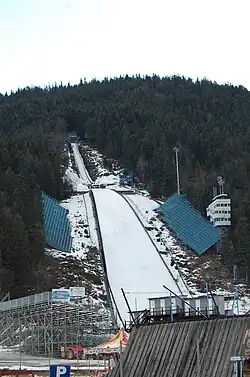
The organizers prepared 40,000 ticketed seats in the stands for both competitions. Tickets were sold at prices of 2 PLN (concession) and 5 PLN (standard).[9]
A lack of sufficient snow posed challenges for the organizers. However, sub-zero temperatures allowed the use of snow cannons, and snow was also transported from the Morskie Oko area.[9]
In addition to the World Cup events, a ceremony for the Olympic oath of Polish ski jumping representatives for the 1998 Winter Olympics in Nagano was planned in Zakopane. The ceremony took place on 17 January, following the first competition. The oath was taken by Krystian Długopolski, Łukasz Kruczek, Adam Małysz, Robert Mateja, and Wojciech Skupień.[10]
Event schedule
The first official training session took place on 16 January 1998, with the second individual competition concluding the event two days later. The schedule included two individual competitions, two qualifying rounds, and three official training sessions.[9]
| Date | Time | Event |
|---|---|---|
| 16 January 1998 | 1:00 PM | Official training on K-116 hill (3 series) |
| 17 January 1998 | 10:00 AM | Qualifying round for the individual competition on K-116 hill |
| 1:00 PM | Start of the first round of the individual competition on K-116 hill, second round of the individual competition | |
| 18 January 1998 | 10:00 AM | Qualifying round for the individual competition on K-116 hill |
| 1:00 PM | Start of the first round of the individual competition on K-116 hill, second round of the individual competition |
Venue
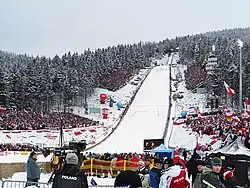
The 1998 Zakopane World Cup competitions were held at Wielka Krokiew named after Stanisław Marusarz, located on the northern slope of Krokiew in the Western Tatras. Two individual competitions took place at the venue.[9] Wielka Krokiew had previously hosted World Cup events in 1980, 1990, and 1996, with competitions planned for 1981 but canceled.[11]
| Venue | Location | K-point | Venue record | |||
|---|---|---|---|---|---|---|
|
Wielka Krokiew |  Zakopane Zakopane
|
K-116 | 130.0 m[10][12] |  Primož Peterka Primož Peterka
|
27 January 1996 |
Competition overview
Training sessions (16 January 1998)
The first training session began on Friday, 16 January, at 1:00 PM.[9] It was repeatedly interrupted due to the foehn wind.[13] The starting gate was lowered three times. Ultimately, after 68 jumpers completed their attempts, the training was canceled, and the remaining sessions were not held.[14] Among those who jumped, Henning Stensrud achieved the longest distance of 129 m. Toni Nieminen jumped 112 m, and Wojciech Skupień reached 110.5 m.[13] The session was canceled before Andreas Goldberger could attempt his jump. Earlier, Dieter Thoma had withdrawn from the training.[13]
Qualification for the first individual competition (17 January 1998)
The qualifying round began on 17 January 1998 at 10:00 AM,[9] as the wind subsided.[15] The qualification took place in favorable weather conditions and was won by Kazuyoshi Funaki, who jumped 119 m. The World Cup runner-up, Dieter Thoma, landed 2.5 m farther but received 5 points lower for style, losing to Funaki by 0.5 points. Third was Martin Schmitt, the best among those fighting for qualification, also jumping 119 m. Fourth was Kristian Brenden, who jumped 120.5 m, making him, alongside Thoma, the only jumper to exceed 120 m.[1]
A total of 80 athletes from 16 countries participated in the qualifications.[1]
First individual competition (17 January 1998)

.jpg)
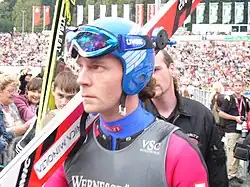
The first individual competition began on 17 January at 1:00 PM.[9] Thirty minutes before the start, light rain began to fall.[15] The competition opened with Switzerland's Marco Steinauer, who jumped 95 m. The next jumper, Roland Wakolm, landed 6 m farther, taking the lead. The fifth jumper, Roland Audenrieth, jumped 105.5 m and assumed the lead. He held it despite attempts by others, including Wojciech Skupień, who jumped 99.5 m and was third. As the competition progressed, rain intensified, worsening conditions on the takeoff.[16]
Audenrieth remained in the lead until the 20th jumper, Robert Mateja, who jumped 106.5 m, surpassing him by 7.3 points. Adam Małysz, jumping next, landed at 94.5 m, placing lower.[15][17] Kristian Brenden jumped 99 m, taking fifth place. Increasing rain led to shorter jumps by subsequent competitors. The 35th jumper, Henning Stensrud, landed at 109 m, becoming the new leader. The 1996 Zakopane World Cup winner, Andreas Goldberger, managed only 88.5 m.[18]
Before the top 10 World Cup athletes jumped, hail began to fall.[15][17] The final 10 started with Stefan Horngacher at 83 m. Sven Hannawald and Janne Ahonen jumped 97 m and 98 m, respectively, placing in the top ranks. Hiroya Saitō reached 95.5 m, while defending World Cup champion Primož Peterka and Andreas Widhölzl both hit 94 m. Finland's Jani Soininen jumped 89 m, Four Hills Tournament winner Kazuyoshi Funaki 87 m, Dieter Thoma 86.5 m, and World Cup leader Masahiko Harada 96.5 m. Thoma, Funaki, Soininen, Horngacher, and Goldberger failed to advance to the final round. After the first round, Henning Stensrud led, followed by Robert Mateja, Roland Audenrieth, Roland Wakolm, Wojciech Skupień, and Kristian Brenden.[19]
Before the final round, the hail turned to sleet, and the jury extended the takeoff by two meters.[15] The second round began with Kazuya Yoshioka jumping 88.5 m. The lead changed after Hansjörg Jäkle jumped 97 m. Jäkle held the lead until Reinhard Schwarzenberger, 26th after the first round (93 m), jumped 105.5 m, taking an 18.2-point lead. Primož Peterka jumped 97 m, taking second. The lead changed again with Martin Schmitt, who matched Schwarzenberger's distance but led by 2.3 points. Poland's Adam Małysz, 21st after the first round, jumped 92.5 m, placing seventh. Schmitt was overtaken by Andreas Widhölzl, 18th after the first round, who jumped 107 m.[18]
The final 10 opened with Masahiko Harada, who jumped 104 m, placing just behind Widhölzl. Sven Hannawald jumped 108 m, taking the lead. Lasse Ottesen, eighth after the first round, landed at 89 m, losing his top position. Janne Ahonen jumped 107 m, taking the lead by 0.5 points over Kristian Brenden, who also jumped 106 m. Wojciech Skupień, fifth after the first round, jumped 88 m, dropping to the lower ranks. Roland Wakolm jumped 91 m, also falling out of the top 10. Roland Audenrieth, third after the first round, jumped 93.5 m, finishing ninth. Robert Mateja matched Audenrieth's 93.5 m, securing sixth place. First-round leader Henning Stensrud jumped 87.5 m, finishing 13th.[18]
Thus, the first individual World Cup competition in Zakopane in 1998 was won by Kristian Brenden, the first Norwayn to win a World Cup event at Wielka Krokiew.[11] This was Brenden's second career World Cup victory.[20] Janne Ahonen and Sven Hannawald took the remaining podium places.[21] Fifty athletes from 13 countries competed in the event.[18]
Qualification for the second individual competition (18 January 1998)
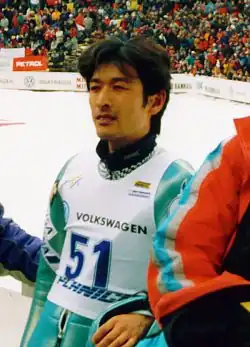
On Sunday, 18 January, at 10:00 AM, the qualifying round for the second individual competition in Zakopane began. It concluded with a victory for Sven Hannawald, who jumped 114 m, defeating his compatriot Hansjörg Jäkle (112.5 m) by 3.2 points. Third was Kristian Brenden, the previous day's winner, who jumped 112 m and was the best among those competing for qualification.[2] Unlike Saturday's event, the competition took place in sunny, windless conditions.[16]
Short jumps in the qualifying round were recorded by Primož Peterka (79 m), Dieter Thoma (67 m), and Andreas Widhölzl (61 m), who placed 73rd, 78th, and 79th, respectively. However, their positions in the top 15 of the World Cup standings guaranteed their participation in the main event.[2]
Eighty athletes from 16 countries participated in the qualifications.[2]
Second individual competition (18 January 1998)

The second individual competition at Wielka Krokiew began on 18 January at 1:00 PM.[9] The event opened with Andrzej Młynarczyk, who jumped 89 m. Łukasz Kruczek, jumping next, landed 6.5 m farther. The third jumper, Ján Zelenčík, reached 107 m, surpassing the Polish athletes. Andrey Lyskovets matched Zelenčík's distance but took the lead with higher style points. Łyskawiec held the lead until the 11th jumper, Wojciech Skupień, who landed at 108 m. The 12th jumper, Christof Duffner, jumped 109 m, overtaking Skupień. The 18th jumper, František Jež, took the lead with a 113 m jump.[22]
The 20th jumper, Poland's Adam Małysz, landed at 107 m, placing fifth, tied with Łyskawiec. The 23rd jumper, Roar Ljøkelsøy, matched Jež's 113 m, sharing the lead. The 25th jumper, Poland's Robert Mateja, jumped 111.5 m, taking third behind Jež and Ljøkelsøy. The lead changed with the 27th jumper, Jon Petter Sandaker, who jumped 114.5 m, leading by 1.7 points.[22]
The next Norwayn, Kristian Brenden, jumped 115.5 m, just shy of the K-point, taking the lead. The 37th jumper, Andreas Goldberger, jumped 116 m, overtaking Brenden. The 40th jumper, Hansjörg Jäkle, reached 124 m but was surpassed by Sven Hannawald, who jumped 120.5 m and took the lead with better style points. Hiroya Saitō, jumping next, landed at 121 m with even higher style points, leading Hannawald by 0.1 points.[22]
Saitō's lead lasted until Primož Peterka jumped 124 m, taking a 6.5-point lead. Peterka held the lead against Janne Ahonen (117.5 m), Andreas Widhölzl (119 m), Jani Soininen (117 m), Kazuyoshi Funaki (121.5 m), and Dieter Thoma (121.5 m). The final jumper, World Cup leader Masahiko Harada, jumped 102 m, finishing 37th and missing the final round. At the halfway point, Peterka led, followed by Funaki and Saitō.[22]
The second round began with Martin Schmitt, 30th after the first round, jumping 83 m. Andrey Lyskovets, jumping next, landed 15.5 m farther, taking the lead. Adam Małysz, tied for 28th, jumped 91.5 m, placing second.[23]
Wojciech Skupień jumped 102.5 m, taking the lead, but was overtaken by Reinhard Schwarzenberger (106.5 m). The lead changed again with Kimmo Savolainen (107 m) and Christof Duffner (109 m). Lasse Ottesen then jumped 109 m, taking the lead. The next three jumpers – Kazuya Yoshioka (108 m), Gerd Siegmund (110 m), and Martin Höllwarth (110.5 m) – each took the lead.[23]
Robert Mateja, 17th after the first round, jumped 103.5 m, dropping to seventh. Ari-Pekka Nikkola, tied with Mateja, jumped 110.5 m, leading Höllwarth by 2.9 points. František Jež jumped 108 m, taking third. Roar Ljøkelsøy jumped 109 m, maintaining a top position. Jon Petter Sandaker jumped 107 m, falling to ninth. Kristian Brenden jumped 108.5 m, securing a top-10 finish. Stefan Horngacher, 13th after the first round, jumped 111.5 m, taking the lead.[23]
In the final round, Andreas Widhölzl jumped 85 meters, which caused him to fall to the third ten of the standings, ahead of only two competitors – Małysz and Schmitt. Dieter Thoma, however, overtook the leading Finns by landing at 124 meters in the second round. Hansjörg Jäkle reached a result seven meters shorter and, after his jump, held fourth place behind Thoma, Ahonen, and Soininen. Fourth after the first round, Sven Hannawald executed the longest jump of both competition rounds with 128.5 meters, thereby taking the lead in the event, 11.6 points ahead of Thoma. Next on the start gate was Hiroya Saitō, who landed 3.5 meters shorter than the German before him, placing him in second position. The second-ranked athlete after the first round, Kazuyoshi Funaki, jumped 128 meters and edged out the current leader, Hannawald, by 0.1 points.[23]
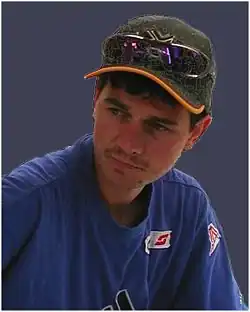
Only one jumper remained at the start – Primož Peterka. The Slovenian jumped 127 meters,[24] which was enough to win a World Cup competition for the 10th time in his career and the first time that season.[25] He also became the first ski jumper in history to win twice in a World Cup event held in Zakopane.[11] Just behind Peterka were Funaki and Hannawald. The best of the Polish competitors was Robert Mateja, who placed 23rd.[24]
Fifty athletes from 14 countries competed in the event.[23]
World Cup standings after the Zakopane competitions
Following the events in Zakopane, several changes occurred among the top competitors in the World Cup standings. Kazuyoshi Funaki moved up to second place, overtaking Dieter Thoma. Primož Peterka advanced from sixth to fifth position, ahead of Andreas Widhölzl. Janne Ahonen climbed from eighth to seventh, pushing Hiroya Saitō down one spot. Jaroslav Sakala dropped from 13th to 15th place, giving way to Martin Höllwarth (up from 15th to 13th) and Andreas Goldberger (who remained in 14th). There were no changes in the lineup of athletes within the top 15 of the overall World Cup classification.[26]
In the Nations Cup standings, Japan remained in first place. Germany held on to second position, while Finland dropped to third.[26]
| World Cup standings after Zakopane competitions[26] | ||||
|---|---|---|---|---|
| Rank | Athlete | Country | Points | Deficit to leader |
| 1. | Masahiko Harada | Japan | 774 | – |
| 2. | Kazuyoshi Funaki | Japan | 664 | 110 |
| 3. | Dieter Thoma | Germany | 663 | 111 |
| 4. | Jani Soininen | Finland | 597 | 177 |
| 5. | Primož Peterka | Slovenia | 547 | 227 |
| 6. | Andreas Widhölzl | Austria | 504 | 270 |
| 7. | Janne Ahonen | Finland | 493 | 281 |
| 8. | Hiroya Saitō | Japan | 474 | 300 |
| 9. | Sven Hannawald | Germany | 448 | 326 |
| 10. | Stefan Horngacher | Austria | 355 | 419 |
| 11. | Noriaki Kasai | Japan | 305 | 469 |
| 12. | Hansjörg Jäkle | Germany | 286 | 488 |
| 13. | Martin Höllwarth | Austria | 262 | 512 |
| 14. | Andreas Goldberger | Austria | 240 | 534 |
| 15. | Jaroslav Sakala | Czech Republic | 239 | 535 |
| 16. | Kimmo Savolainen | Finland | 199 | 575 |
| 17. | Henning Stensrud | Norway | 198 | 576 |
| 18. | Kristian Brenden | Norway | 193 | 581 |
| 19. | Reinhard Schwarzenberger | Austria | 182 | 592 |
| 20. | Ari-Pekka Nikkola | Finland | 181 | 593 |
| 21. | Kazuya Yoshioka | Japan | 180 | 594 |
| 22. | Michael Wagner | Germany | 176 | 598 |
| 23. | Mika Laitinen | Finland | 164 | 610 |
| 24. | Sylvain Freiholz | Switzerland | 116 | 658 |
| 25. | Jon Petter Sandaker | Norway | 100 | 674 |
| 26. | Martin Schmitt | Germany | 98 | 676 |
| 27. | Wolfgang Loitzl | Austria | 95 | 679 |
| 28. | Ronny Hornschuh | Germany | 86 | 688 |
| 29. | Robert Mateja | Poland | 80 | 694 |
| 30. | Roar Ljøkelsøy | Norway | 78 | 696 |
| 30. | Kenji Suda | Japan | 78 | 696 |
| 32. | Takanobu Okabe | Japan | 76 | 698 |
| 33. | Michal Doležal | Czech Republic | 64 | 710 |
| 34. | Yoshikazu Norota | Japan | 60 | 714 |
| 34. | Lasse Ottesen | Norway | 60 | 714 |
| 36. | František Jež | Czech Republic | 56 | 718 |
| 37. | Gerd Siegmund | Germany | 52 | 722 |
| 38. | Valery Kobelev | Russia | 50 | 724 |
| 39. | Nicolas Dessum | France | 46 | 728 |
| 40. | Matthias Wallner | Austria | 44 | 730 |
| 41. | Adam Małysz | Poland | 43 | 731 |
| 41. | Matti Hautamäki | Finland | 43 | 731 |
| 43. | Hideharu Miyahira | Japan | 41 | 733 |
| 44. | Tommy Ingebrigtsen | Norway | 38 | 736 |
| 45. | Robert Křenek | Czech Republic | 33 | 741 |
| 45. | Espen Bredesen | Norway | 33 | 741 |
| 47. | Roberto Cecon | Italy | 31 | 743 |
| 48. | Christof Duffner | Germany | 30 | 744 |
| 48. | Bruno Reuteler | Switzerland | 30 | 744 |
| 50. | Roland Audenrieth | Germany | 26 | 748 |
| 51. | Peter Žonta | Slovenia | 25 | 749 |
| 52. | Wojciech Skupień | Poland | 23 | 751 |
| 52. | Jussi Hautamäki | Finland | 23 | 751 |
| 54. | Sturle Holseter | Norway | 22 | 752 |
| 55. | Jérôme Gay | France | 20 | 754 |
| 56. | Simon Ammann | Switzerland | 16 | 758 |
| 57. | Roland Wakolm | Austria | 15 | 759 |
| 58. | Urban Franc | Slovenia | 13 | 761 |
| 59. | Jakub Janda | Czech Republic | 12 | 762 |
| 60. | Miha Rihtar | Slovenia | 10 | 764 |
| 60. | Håvard Lie | Norway | 10 | 764 |
| 62. | Morten Ågheim | Norway | 9 | 765 |
| 63. | Ville Kantee | Finland | 8 | 766 |
| 64. | Choi Heung-chul | South Korea | 6 | 768 |
| 65. | Andrey Lyskovets | Belarus | 4 | 770 |
| 65. | Michael Kury | Austria | 4 | 770 |
| 67. | Randy Weber | United States | 3 | 771 |
| 67. | Lucas Chevalier-Girod | France | 3 | 771 |
| 69. | Aleksey Shibko | Belarus | 2 | 772 |
| 69. | Ralf Gebstedt | Germany | 2 | 772 |
| 69. | Marco Steinauer | Switzerland | 2 | 772 |
Team lineups
Below is a summary of the team lineups for all national squads that took part in the Ski Jumping World Cup competitions in Zakopane in 1998. Out of the top 15 athletes in the overall World Cup standings, only Noriaki Kasai, who was ranked 11th before the event in Poland, was absent from the start list.[4]
As the host nation, Poland was entitled to field an additional 10 competitors in the qualification rounds from the so-called "national quota", which applies to the two competitions held in the country.[27] As a result, 14 Polish athletes took part in the qualification for each of the events at the Wielka Krokiew hill.[1][2]
| Athlete | Date of birth | World Cup rank[4] | First competition
27 January 1996[28] |
Second competition
28 January 1996[29] |
First competition
17 January 1998[18] |
Second competition
18 January 1998[23] |
|---|---|---|---|---|---|---|
 Austria (8) Austria (8)
| ||||||
| Andreas Goldberger | 29 November 1972 | 14 | 2 | 1 | 37 | 12 |
| Stefan Horngacher | 20 September 1969 | 10 | 14 | 15 | 44 | 9 |
| Martin Höllwarth | 13 April 1974 | 15 | 20 | 38 | 7 | 16 |
| Wolfgang Loitzl | 13 January 1980 | 23 | – | 35 | 24 | |
| Roland Wakolm | 1979 | – | – | 39 | 16 | |
| Matthias Wallner | 8 May 1975 | 36 | 25 | 23 | 45 | 38 |
| Reinhard Schwarzenberger | 7 January 1977 | 22 | 3 | 12 | 9 | 25 |
| Andreas Widhölzl | 14 October 1976 | 5 | 5 | 13 | 4 | 28 |
 Belarus (4) Belarus (4)
| ||||||
| Siarhiej Babrou | 1978 | – | – | q | q | |
| Andrey Lyskovets | 7 October 1974 | – | – | 47 | 27 | |
| Aleksandr Sinyavsky | 9 March 1977 | – | – | q | q | |
| Aleksey Shibko | 27 September 1977 | 66 | – | q | 42 | |
 Czech Republic (4) Czech Republic (4)
| ||||||
| Michal Doležal | 11 March 1978 | 30 | – | 42 | 36 | |
| František Jež | 16 December 1970 | 40 | 11 | 24 | q | 14 |
| Robert Křenek | 12 November 1974 | 45 | – | 26 | 46 | |
| Jaroslav Sakala | 14 July 1969 | 13 | 49 | 32 | 26 | 46 |
 Finland (5) Finland (5)
| ||||||
| Janne Ahonen | 11 May 1977 | 8 | 17 | 19 | 2 | 6 |
| Toni Nieminen | 31 May 1975 | – | 46 | 29 | 31 | 35 |
| Ari-Pekka Nikkola | 16 May 1969 | 21 | 4 | 3 | 24 | 13 |
| Kimmo Savolainen | 2 August 1974 | 16 | – | 33 | 22 | |
| Jani Soininen | 12 November 1972 | 4 | 10 | 20 | 40 | 6 |
 France (1) France (1)
| ||||||
| Lucas Chevalier-Girod | 26 January 1976 | 64 | – | 36 | 41 | |
 Japan (4) Japan (4)
| ||||||
| Kazuyoshi Funaki | 27 April 1975 | 3 | – | 39 | 2 | |
| Masahiko Harada | 9 May 1968 | 1 | – | 5 | 37 | |
| Hiroya Saitō | 1 September 1970 | 7 | – | 21 | 4 | |
| Kazuya Yoshioka | 9 September 1978 | 19 | – | 30 | 19 | |
 Kazakhstan (1) Kazakhstan (1)
| ||||||
| Aleksandr Korobov | 1 April 1978 | – | – | q | q | |
 Germany (8) Germany (8)
| ||||||
| Roland Audenrieth | 2 July 1979 | – | – | 10 | 44 | |
| Christof Duffner | 16 December 1971 | 61 | 16 | 8 | 15 | 21 |
| Sven Hannawald | 9 November 1974 | 9 | – | 3 | 3 | |
| Ronny Hornschuh | 2 February 1975 | 31 | 37 | 40 | 11 | 50 |
| Hansjörg Jäkle | 19 October 1971 | 12 | 30 | 33 | 18 | 8 |
| Martin Schmitt | 29 January 1978 | 29 | – | 8 | 30 | |
| Gerd Siegmund | 7 February 1973 | 51 | 21 | 21 | 12 | 17 |
| Dieter Thoma | 19 October 1969 | 2 | 12 | 39 | 43 | 5 |
 Norway (8) Norway (8)
| ||||||
| Tom Aage Aarnes | 25 January 1977 | – | – | 32 | q | |
| Kristian Brenden | 12 June 1976 | 28 | – | 1 | 10 | |
| Sturle Holseter | 9 April 1976 | 61 | 14 | 19 | 14 | q |
| Håvard Lie | 21 May 1975 | 56 | – | 38 | 47 | |
| Roar Ljøkelsøy | 31 May 1976 | 33 | 8 | 4 | 49 | 11 |
| Lasse Ottesen | 8 April 1974 | 39 | 28 | 36 | 22 | 20 |
| Jon Petter Sandaker | 24 February 1974 | 25 | – | 46 | 18 | |
| Henning Stensrud | 20 August 1977 | 17 | – | 13 | 33 | |
| Poland (15)[30]
| ||||||
| Aleksander Bojda | 1978 | – | q | q | q | q |
| Krystian Długopolski | 3 August 1980 | – | q | q | q | q |
| Andrzej Galica | 6 June 1980 | – | q | q | q | q |
| Bartłomiej Gąsienica-Sieczka | 26 September 1973 | – | q | q | q | q |
| Mirosław Grzybowski | 30 January 1977 | – | – | – | q | |
| Marek Gwóźdź | 24 May 1977 | – | 41 | 48 | q | – |
| Andrzej Karpiel | 1978 | – | – | q | q | |
| Łukasz Kruczek | 1 November 1975 | – | 43 | q | q | 45 |
| Mariusz Maciaś | 1 January 1981 | – | – | q | q | |
| Adam Małysz | 3 December 1977 | 42 | 9 | 6 | 23 | 29 |
| Robert Mateja | 5 October 1974 | 44 | 48 | 47 | 6 | 23 |
| Andrzej Młynarczyk | 1973 | – | q | q | q | 49 |
| Marcin Sitarz | 12 October 1978 | – | q | q | q | q |
| Wojciech Skupień | 9 March 1976 | 53 | 29 | 28 | 28 | 26 |
| Grzegorz Śliwka | 19 April 1982 | – | – | q | q | |
 Russia (4) Russia (4)
| ||||||
| Arthur Khamidulin | 30 April 1977 | – | – | q | q | |
| Maxim Cubina | 12 February 1978 | – | – | q | q | |
| Nikolay Petrushin | 4 June 1979 | – | – | q | q | |
| Aleksandr Volkov | 28 April 1978 | – | – | q | 40 | |
 Slovakia (4) Slovakia (4)
| ||||||
| Marián Bielčík | 27 August 1973 | – | 40 | 25 | q | q |
| Martin Mesík | 17 October 1979 | – | q | 41 | 48 | q |
| Dušan Oršula | 23 August 1979 | – | – | q | q | |
| Ján Zelenčík | 17 October 1979 | – | – | q | 32 | |
| Slovenia (5)
| ||||||
| Urban Franc | 5 June 1975 | 54 | – | 34 | q | |
| Jaka Grosar | 4 April 1978 | – | – | q | q | |
| Primož Peterka | 28 February 1979 | 6 | 1 | 2 | 17 | 1 |
| Jure Radelj | 26 November 1977 | – | – | 41 | q | |
| Peter Žonta | 9 January 1979 | 47 | – | 50 | 34 | |
.svg.png) Switzerland (4) Switzerland (4)
| ||||||
| Sylvain Freiholz | 23 November 1974 | 23 | 13 | 22 | 19 | 15 |
| Andreas Küttel | 25 April 1979 | – | – | q | q | |
| Bruno Reuteler | 2 April 1971 | 46 | 22 | 17 | 27 | 43 |
| Marco Steinauer | 13 April 1976 | – | 24 | 34 | 29 | q |
 Ukraine (5) Ukraine (5)
| ||||||
| Volodymyr Hlyvka | 24 August 1973 | – | – | q | q | |
| Liubym Kohan | 2 July 1975 | – | – | – | q | |
| Ivan Kozlov | 6 May 1978 | – | – | q | q | |
| Yurii Mykytynets | 12 November 1974 | – | – | q | q | |
| Volodymyr Stechniovich | 1979 | – | – | q | – | |
 Italy (2) Italy (2)
| ||||||
| Roberto Cecon | 28 December 1971 | 47 | – | 25 | 31 | |
| Ivan Lunardi | 15 May 1973 | – | – | q | q | |
Legend:
q – athlete did not qualify for the main competition.
– – athlete was not entered for the qualification round.
References
- ^ a b c d "97/98 FIS WORLD CUP SKI-JUMPING - 13th World Cup Competition - Qualification Round". www.skijump-db.net. Archived from the original on 28 March 2004.
- ^ a b c d e "97/98 FIS WORLD CUP SKI-JUMPING - 14th World Cup Competition - Qualification Round". www.skijump-db.net. Archived from the original on 22 June 2004.
- ^ a b "Skoki Narciarskie – Puchar Świata 1997/1998" [Ski Jumping – World Cup 1997/1998]. skokinarciarskie.pl (in Polish). Retrieved 15 July 2025.
- ^ a b c d e "Puchar Świata 1997/1998 - Klasyfikacja po konkursie: 11.01.1998, Ramsau K-90" [World Cup 1997/1998 – Standings after the Competition: 11 January 1998, Ramsau K-90]. skokinarciarskie.pl (in Polish). Retrieved 15 July 2025.
- ^ a b "Skoki Narciarskie – Turniej Czterech Skoczni 1997/1998" [Ski Jumping – Four Hills Tournament 1997/1998]. skokinarciarskie.pl (in Polish). Retrieved 15 July 2025.
- ^ Łozowski, Andrzej (7 January 1998). "Nie było lądowania na Księżycu" [There Was No Moon Landing]. Rzeczpospolita (in Polish). 5.
- ^ "Skoki Narciarskie – Bischofshofen, Turniej Czterech Skoczni 1997/1998: 06.01.1998 - Bischofshofen (Austria) K-120" [Ski Jumping – Bischofshofen, Four Hills Tournament 1997/1998: 06.01.1998 - Bischofshofen (Austria) K-120]. skokinarciarskie.pl (in Polish). Retrieved 15 July 2025.
- ^ "Skoki Narciarskie – Ramsau, Puchar Świata 1997/1998: 11.01.1998 - Ramsau (Austria) K-90" [Ski Jumping – Ramsau, World Cup 1997/1998: 11.01.1998 - Ramsau (Austria) K-90]. skokinarciarskie.pl (in Polish). Retrieved 15 July 2025.
- ^ a b c d e f g h Przybyło, Jacek (15 January 1998). "Starczy miejsc i białego puchu" [Plenty of Space and White Powder Snow]. Gazeta Wyborcza (in Polish). 12.
- ^ a b "Debiut na Krokwi" [Debut on the Krokiew]. Gazeta Wyborcza (in Polish). 14. 17 January 1998.
- ^ a b c "Results - Zakopane, World Cup, Ski Jumping". fis-ski.com. Archived from the original on 16 September 2016.
- ^ "Wielka Krokiew - Zakopane". skisprungschanzen.com (in Polish). Retrieved 15 July 2025.
- ^ a b c Błoński, Robert; Pol, Michał (17 January 1998). "Zawiana krokiew" [Snow-Blown Krokiew]. Gazeta Wyborcza (in Polish). 14.
- ^ Przybyło, Jacek (17 January 1998). "Powiało na Krokwi" [It Got Windy on the Krokiew]. Gazeta Wyborcza (in Polish). 14.
- ^ a b c d e Błoński, Robert (19 January 1998). "W deszczu i słońcu" [In Rain and Sunshine]. Gazeta Wyborcza (in Polish). 15.
- ^ a b Jóźwik, Marek (19 January 1998). "Z deszczu pod słońce" [From Rain into Sunshine]. Rzeczpospolita. 15.
- ^ a b Bucholz, Adam (10 January 2013). "Historia konkursów Pucharu Świata na Wielkiej Krokwi" [History of World Cup Competitions at Wielka Krokiew]. www.skijumping.pl (in Polish). Retrieved 15 July 2025.
- ^ a b c d e "97/98 FIS WORLD CUP SKI-JUMPING - 13th World Cup Competition". www.skijump-db.net. Archived from the original on 10 September 2005.
- ^ "Skoki Narciarskie – Zakopane, Puchar Świata 1997/1998: 17.01.1998 - Zakopane (Polska) K-116: wyniki po I serii" [Ski Jumping – Zakopane, World Cup 1997/1998: 17.01.1998 - Zakopane (Poland) K-116: First Round Results]. skokinarciarskie.pl (in Polish). Retrieved 15 July 2025.
- ^ "BRENDEN Kristian - Biography; Category: World Cup, Position: Top 3". www.fis-ski.com. Retrieved 15 July 2025.
- ^ "Skoki Narciarskie – Zakopane, Puchar Świata 1997/1998: 17.01.1998 - Zakopane (Polska) K-116" [Ski Jumping – Zakopane, World Cup 1997/1998: 17 January 1998 – Zakopane (Poland) K-116]. skokinarciarskie.pl (in Polish). Retrieved 15 July 2025.
- ^ a b c d "Skoki Narciarskie – Zakopane, Puchar Świata 1997/1998: 18.01.1998 - Zakopane (Polska) K-116: wyniki po I serii" [Ski Jumping – Zakopane, World Cup 1997/1998: 18.01.1998 - Zakopane (Poland) K-116: First Round Results]. skokinarciarskie.pl (in Polish). Retrieved 15 July 2025.
- ^ a b c d e f "97/98 FIS WORLD CUP SKI-JUMPING - 14th World Cup Competition". www.skijump-db.net. Archived from the original on 8 September 2005.
- ^ a b "Skoki Narciarskie – Zakopane, Puchar Świata 1997/1998: 18.01.1998 - Zakopane (Polska) K-116" [Ski Jumping – Zakopane, World Cup 1997/1998: 18 January 1998 – Zakopane (Poland) K-116]. skokinarciarskie.pl (in Polish). Retrieved 15 July 2025.
- ^ "PETERKA Primoz - Biographie; Category: World Cup, Position: Top 3". www.fis-ski.com. Retrieved 15 July 2025.
- ^ a b c "Skoki Narciarskie – Puchar Świata 1997/1998: Klasyfikacja po konkursie: 18.01.1998, Zakopane K-116" [Ski Jumping – World Cup 1997/1998: Standings after the Competition: 18 January 1998, Zakopane K-116]. skokinarciarskie.pl (in Polish). Retrieved 15 July 2025.
- ^ "Tuzin Polaków poskacze w Zakopanem. "Wszystko idzie wolniej, niż oczekiwałem"" [A Dozen Poles Will Jump in Zakopane. "Everything Is Going Slower Than I Expected"]. sport.tvn24.pl (in Polish). 19 January 2016. Archived from the original on 20 January 2016.
- ^ "FIS-Ski: World Cup - Men's Large Hill 27.01.1996". www.fis-ski.com. Retrieved 15 July 2025.
- ^ "FIS-Ski: World Cup – Men's Large Hill 28.01.1996". www.fis-ski.com. Retrieved 15 July 2025.
- ^ Serafin, Marek (26 January 1996). "Tylko gladiatorzy" [Only Gladiators]. Przegląd Sportowy (in Polish). 19.